
Should kids be paid for chores? What the research actually says

Few parenting questions split a dinner table faster. One camp: "Nobody pays me to unload the dishwasher — chores are what you do because you live here." The other: "Money for work is the most honest lesson there is, start early." Both camps are sure. The evidence is messier, and more useful.
What parents actually do
Most families land somewhere in the middle. US surveys (the best data we have — NZ-specific numbers barely exist) consistently find a majority of parents give some form of allowance, and a majority of those tie at least part of it to work. An AICPA survey found roughly four in five parents who give allowance expect something in return for it. At the same time, a Bankrate survey found a sizeable share of adults think basic chores should simply be expected, unpaid. Parents hold both beliefs at once — which is why the hybrid model below keeps winning.
Amounts, for calibration: Wells Fargo's 2025 study put the average US weekly allowance at about US$37 — but that average is dragged up by teenagers; younger kids typically get a single-digit weekly amount.
The case for paying
- Money skills need money. Saving, trade-offs, and "spent it all on day one" regret can't be taught in theory. Earned money carries more weight than gifted money.
- Effort→reward is an honest mental model. The link between doing the work and getting the payoff is the same one adult life runs on.
- It ends the random-treat economy. If kids have earnings, "can I have a Slurpee?" becomes "do you have the money?" — a much better conversation.
The case against paying (for everything)
- The undermining effect is real. Decades of motivation research (Deci & Ryan's self-determination work is the classic line) shows external rewards can crowd out intrinsic motivation for tasks kids might own anyway. Pay a child for every act of contribution and you can accidentally teach them contribution is a transaction.
- The opt-out problem. Pure pay-per-chore gives kids a legal exit: "I don't need money this week, so no, I won't help." Plenty of parents have been outlawyered by a nine-year-old here.
- Family isn't an employer. Some jobs are about belonging. Paying a kid to bring their plate to the bench misprices what the act means.
Worth noting: a University of Michigan analysis found doing chores in early childhood predicted later competence and wellbeing — the chores themselves matter, however you reward them. And longitudinal claims that "chores predict success" (often traced to the Harvard Grant Study) are correlational. Chores are good for kids; no study proves a payment model either way.
The hybrid model that keeps winning
The pattern that survives contact with real families splits work into three tiers:
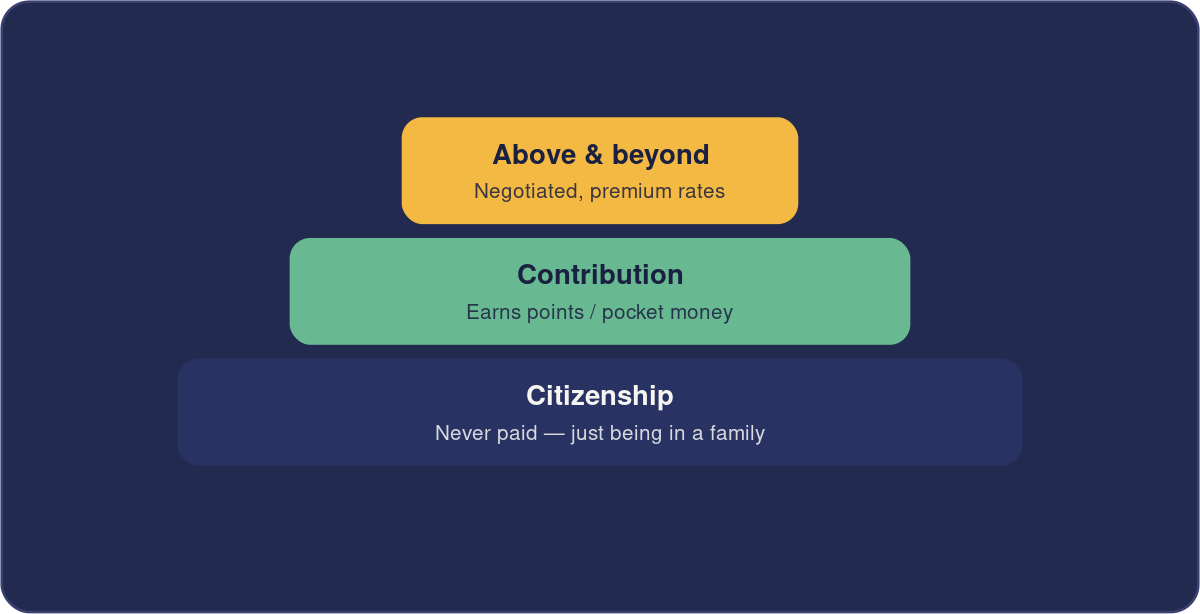
- Citizenship jobs — never paid. Plate to the bench, clothes in the hamper, tidying your own mess. These are the price of being in a family, and framing matters: they're not "free chores", they're just what we do.
- Contribution jobs — earn points or pocket money. Dishwasher, vacuuming, bins, laundry rotation. Real work that helps the whole household. This is where effort→reward gets taught.
- Above-and-beyond jobs — negotiated, premium rates. Washing the car, clearing the garage, water-blasting the deck. Closer to real contracting: agree the job, the standard, and the price up front.
The tier boundaries move as kids grow — an eight-year-old's contribution job is a fourteen-year-old's citizenship job. (Our chores-by-age guide covers what's realistic when.)
Points first, money second
One refinement we'd push hard, especially under about age ten: reward in points, and make cash one of the things points buy. Points pay out instantly (no waiting for Sunday), they can buy non-monetary rewards too — screen time, movie night, choosing dinner — and a "save up for the big one" goal teaches delayed gratification before a bank account ever enters the picture. You also dodge the awkward mid-week cash float entirely.
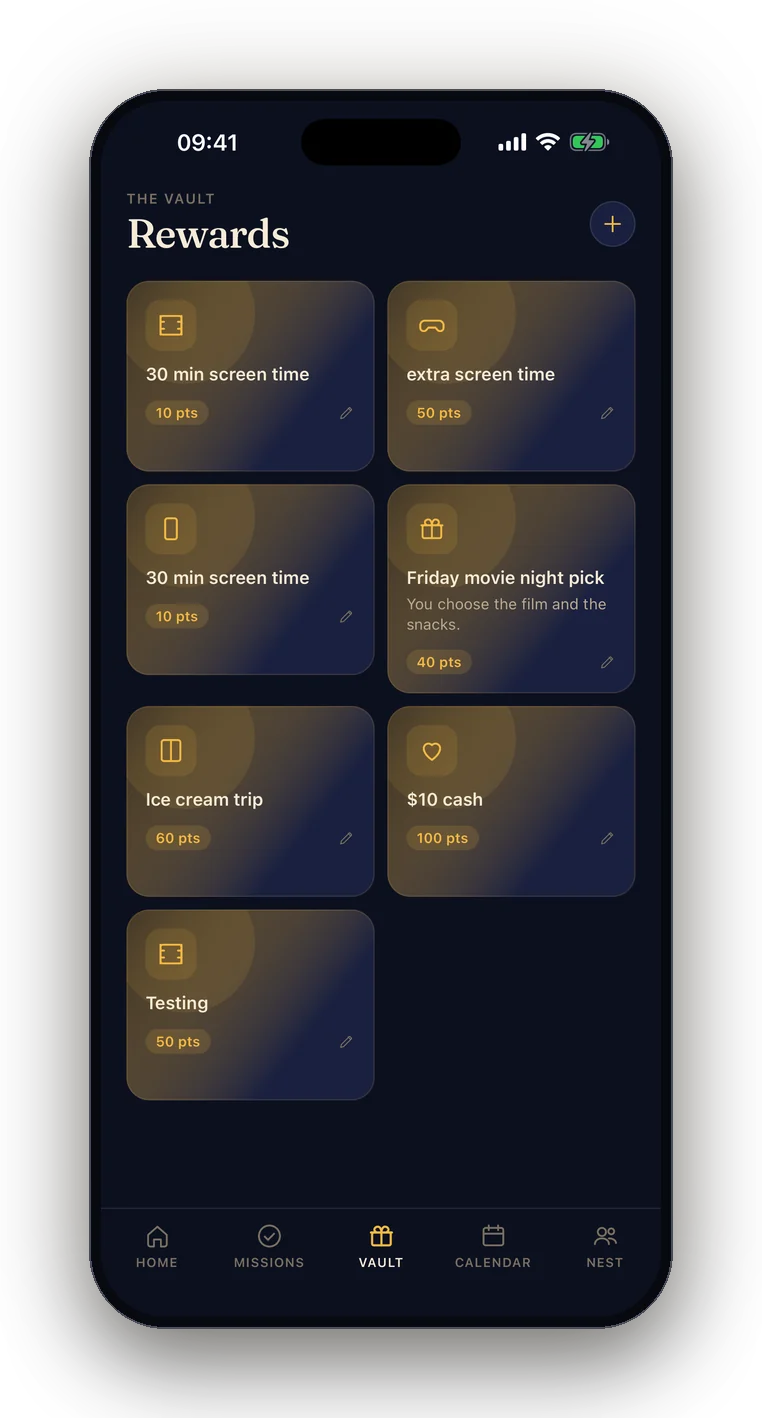
FamOwl runs exactly this model. Citizenship jobs as zero-point missions if you want them visible, contribution jobs earning points, and rewards where points buy screen time, outings — or cash out as pocket money. You set every value; FamOwl never touches real money.
Get FamOwl freeSome FamOwl articles are drafted with AI assistance and reviewed by our team. They're general information, not professional, financial, or medical advice — every family is different, so use your own judgement. FamOwl isn't liable for decisions made based on this content.